
Post
T-Shirt Printing Methods Explained: Which One Is Perfect for Your Custom Tee
Jun
T-Shirt Printing Methods Explained: Which One Is Right for Your Custom Tee
Why Understanding Printing Methods Matters
The printing method used on a graphic t-shirt determines how the final product looks, how long the print lasts, what it costs to produce, and how the garment feels against your skin. Understanding these differences helps you make informed decisions when buying custom or graphic tees.
At codai.click, we use the printing methods that deliver the best combination of visual quality and long-term durability for each specific design type. Explore our graphic tee collection at codai.click/shop.
Screen Printing: The Industry Standard for Bold, Durable Graphics
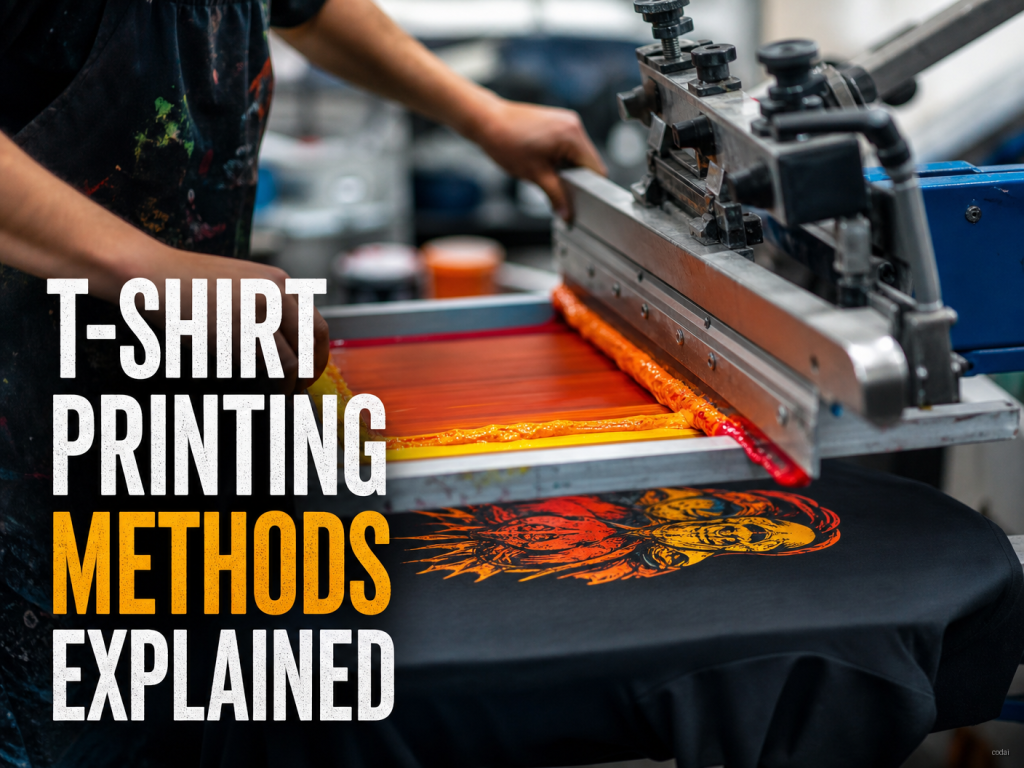
Screen printing is the most widely used commercial t-shirt printing method and has been the industry standard for mass-production graphic tees since the nineteen sixties. It involves pushing ink through a fine mesh screen onto the fabric, with a separate screen required for each color in the design.
Screen printing produces highly durable, vibrant prints that maintain their color intensity and edge definition through extensive washing. The ink sits on top of the fabric rather than bonding with the fibers, which gives screen-printed graphics their characteristic slightly raised texture and bold visual presence.
The primary limitation of screen printing is its cost structure for small runs. Each color requires a separate screen setup, making multi-color designs significantly more expensive for short production runs. For quantities above fifty units, screen printing typically becomes the most cost-effective option available.
Screen printing excels with designs that use a limited number of solid colors with clean edges. It is less effective for photographic images or highly detailed gradients that require many tones to render accurately.
Direct-to-Garment (DTG) Printing: The Digital Revolution in Tee Production
Direct-to-garment printing is the t-shirt industry’s equivalent of inkjet printing. A specialized printer applies water-based ink directly to the fabric surface at the pixel level, making it capable of reproducing full-color photographic images, complex gradients, and highly detailed designs with exceptional accuracy.
DTG printing requires no screens, no setup beyond the digital file, and produces each print individually — making it economically viable for single-unit or small-run custom tees that would be prohibitively expensive through screen printing.
The ink in DTG printing bonds directly with the cotton fibers of the garment. This produces a softer, more integrated feel than screen printing — the print feels like part of the fabric rather than a layer on top of it. The trade-off is that DTG colors are typically slightly less saturated than comparable screen-printed alternatives.
DTG printing works best on one hundred percent cotton garments. Polyester content in the fabric reduces ink absorption and can result in lower print vibrancy and reduced longevity compared to all-cotton alternatives.
The technological evolution of t-shirt printing methods is part of the broader history of the garment. Explore the development of the t-shirt as a medium for graphic expression to understand how printing technology has shaped the graphic tee as we know it today.
Heat Transfer Vinyl (HTV): Precision and Versatility for Custom Designs
Heat transfer vinyl involves cutting designs from colored vinyl material and then heat-pressing them onto the fabric. The result is a clean, sharp-edged design with a slightly raised surface feel and good color accuracy for solid-color artwork.
HTV is particularly effective for simple text-based designs, monograms, and geometric graphics that require precise edge definition. It is also the best method for metallic, holographic, and specialty finish effects that other printing methods cannot replicate.
The primary limitation of heat transfer vinyl is its durability over long periods of wear and washing. The vinyl layer can crack or peel at the edges over time, particularly if the garment is washed in hot water or tumble dried at high heat frequently.
HTV is an excellent option for individual custom pieces and small-batch production but is generally less suitable than screen printing or DTG for the high-volume, everyday graphic tees that dominate commercial production.
Embroidery: When Texture and Dimension Are the Goal
While not strictly a printing method, embroidery deserves inclusion in any discussion of t-shirt graphic application techniques. Embroidered graphics involve stitching the design directly into the fabric using thread, creating a three-dimensional, tactile result that no flat printing method can replicate.
Embroidery is typically applied to the chest area, left breast pocket position, or collar area of t-shirt printing. It communicates premium quality and lasting durability — embroidered logos and graphics show no fading, cracking, or peeling regardless of how many times the garment is washed.
Embroidery is limited to relatively simple, bold designs. Fine details and photographic imagery are impossible to execute accurately in embroidery at t-shirt scale. Color gradients are also not achievable through embroidery.
Sublimation Printing: Brilliant All-Over Color on Synthetic Fabrics
Sublimation printing converts solid dye into gas that bonds permanently with polyester fibers in the fabric at the molecular level. This process produces full-color, all-over prints with exceptional vibrancy, unlimited detail, and absolute durability.
Because the dye becomes part of the fabric at the molecular level rather than sitting on the surface, sublimation prints cannot crack, fade, or peel under any washing conditions. The print remains as vivid after one hundred washes as it was when new.
The critical limitation is fabric requirement. Sublimation works only on polyester or polyester-blend fabrics. It is completely ineffective on cotton, making it unsuitable for premium natural-fiber t-shirts. The feel of polyester is also a significant drawback for many customers who prefer the softness and breathability of cotton.
Which T-shirt Printing Method Should You Choose?
The right printing method depends on your specific priorities. T-shirt printing For premium everyday graphic tees with bold, durable prints, screen printing and DTG printing are the two methods that deliver the best combination of quality, longevity, and value.
At codai.click, we use water-based DTG printing for our detailed graphic designs and screen printing for our bold, high-contrast artwork. This combination ensures that every tee in our range delivers the best possible visual result for the specific design type it carries.
Browse our full graphic tee collection at codai.click/shop and see the print quality for yourself across our complete range.
Conclusion: Print Quality Is the Difference Between a Good Tee and a Great One
Understanding printing methods gives you the knowledge to evaluate graphic tee quality confidently, regardless of where you shop. At codai.click, we apply this knowledge in every production decision to ensure that every shirt in our range meets the highest possible standard for visual quality and print longevity.
