
Post
The Fascinating History of T-Shirts: 7 Remarkable Transformations from Military Underwear to Global Fashion
Jun
The History of T-Shirts: From Military Underwear to Global Fashion Icon
Introduction: The World’s Most Popular Garment
The t-shirt is the single most popular garment on earth. Billions are produced annually, worn across every culture, climate, demographic, and social context imaginable. Yet the garment we know today began its existence as a utilitarian undergarment with no fashion aspirations whatsoever.
The story of how the t-shirt evolved from military-issue underwear to global fashion icon spans over a century and involves the US Navy, Hollywood cinema, rock music, political protest, athletic culture, and the complete transformation of global fashion consumption.
Understanding this history adds a richer dimension to every t-shirt you own and wear. Browse the best expression of this icon’s current evolution at codai.click/shop.
Origins: The T-Shirt as Military Undergarment (Late 1800s to 1910s)
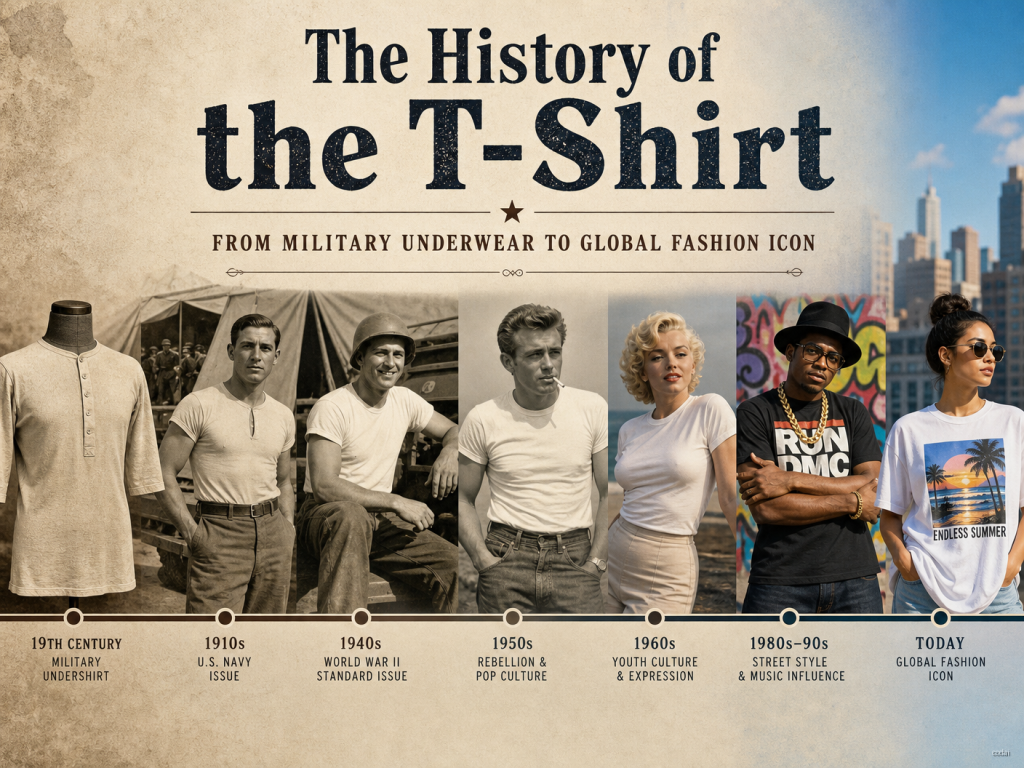
The modern t-shirt evolved from the union suit — a one-piece undergarment worn by American laborers and military personnel throughout the nineteenth century. Workers and soldiers began cutting the union suit in half for easier wearing in warmer conditions, producing a separate upper garment that became the functional predecessor of the modern tee.
The US Navy standardized the white cotton undershirt as part of its uniform in the early twentieth century. This garment — short-sleeved, crew-necked, and collarless — was worn under the uniform shirt as a moisture-absorbing base layer. Its T-shaped cut when laid flat gave the garment its eventual name.
By the First World War, the t-shirt undershirt was standard issue for American, British, and European military forces. Its practicality, comfort, and ease of cleaning made it the default base layer for military personnel across all branches of service.
The Postwar Transition: From Underwear to Outerwear (1940s to 1950s)
The critical shift in the t-shirt’s cultural status occurred in the postwar period. Returning American veterans, accustomed to wearing the comfortable cotton undershirt in warm conditions, continued wearing it as a standalone outer garment during the late nineteen forties.
Two specific cultural moments cemented this shift permanently. In 1951, Marlon Brando appeared in A Streetcar Named Desire wearing a tight white t-shirt as a standalone outer garment — a moment history of t-shirts that transferred the t-shirt’s associations from military utility to masculine sexuality and rebellious energy. James Dean reinforced this transformation in Rebel Without a Cause in 1955, creating the iconic image of the white tee as the uniform of American youth rebellion.
By the end of the nineteen fifties, the t-shirt had crossed the line from underwear to outerwear in the mainstream American cultural consciousness. The garment was no longer something to be hidden under a shirt — it was the shirt.
The Graphic Revolution: T-Shirts as Communication (1960s to 1970s)
The nineteen sixties introduced the concept of the graphic t-shirt — a garment that communicated something beyond its wearer’s physical body. Political movements, musical communities, and counterculture groups discovered that the t-shirt was the most democratic and accessible medium for public communication available.
Screen printing technology made mass-production of graphic tees economically viable during this period. Political slogans, band names, brand logos, and artistic imagery could now be reproduced on cotton in large quantities at accessible price points.
The Woodstock festival in 1969 is frequently cited as a pivotal moment in the graphic tee’s cultural history. Band merchandise tees, event tees, and statement tees all gained significant cultural traction through the music festival circuit of the late sixties and seventies.
Corporate and Athletic Adoption (1970s to 1980s)
The nineteen seventies and eighties saw corporate brands, sports teams, and athletic companies recognize the t-shirt as a marketing vehicle of unprecedented reach and effectiveness. The branded t-shirt became simultaneously merchandise, advertising, and fashion statement.
The rise of athletic culture and fitness as a mainstream lifestyle in the nineteen eighties further elevated the t-shirt’s status. The garment became standard wear for jogging, gym training, and sport participation history of t-shirts — expanding its daily usage from casual wear to active performance contexts.
Designer brands also entered the t-shirt market during this period, beginning a transformation that would eventually make the premium designer tee one of the most commercially significant luxury fashion categories in the global market.
The full documented history of the t-shirt through all of these cultural moments is available at the Wikipedia article on the t-shirt, which provides a comprehensive academic overview of the garment’s evolution.
The Streetwear Era and Global Dominance (1990s to Present)
The nineteen nineties streetwear movement, emerging from the intersection of hip-hop culture, skateboarding, and urban youth fashion, placed the graphic t-shirt at the center of a new global aesthetic movement. Brands like Supreme, Stüssy, and dozens of independent labels built entire business models around the premium graphic tee.
The internet and social media age democratized history of t-shirts this movement further. Independent designers and small t-shirt brands could reach global audiences directly without the infrastructure requirements that had previously made fashion brand-building accessible only to well-funded companies.
Today, the t-shirt market is one of the largest single-product categories in global apparel. Hundreds of millions of tees are sold annually across every price point from fast fashion to luxury designer collaborations.
The T-Shirt’s Current Cultural Moment
In 2025, the t-shirt continues to evolve. Sustainability pressures are driving innovation in organic cotton, recycled fiber blends, and low-water dyeing processes. Customization history of t-shirts technology makes personalized on-demand tee production more accessible than ever. And the graphic tee continues to serve as a primary medium for cultural commentary, brand identity, and personal expression across every demographic worldwide.
At codai.click, our tees are built with respect for this history. Every shirt we make continues the story of a garment that has spent over a century proving its cultural indispensability. Shop the current collection at codai.click/shop.
Conclusion: The Most Significant Garment Ever Made
No other garment in history has achieved the t-shirt’s combination of universal practicality, cultural significance, and democratic accessibility. It is simultaneously the most common and the most culturally loaded item in the global wardrobe.
Wearing a great t-shirt connects you to over a century of history, history of t-shirts rebellion, creativity, and human expression. Make sure the one on your back is worthy of that legacy.
